

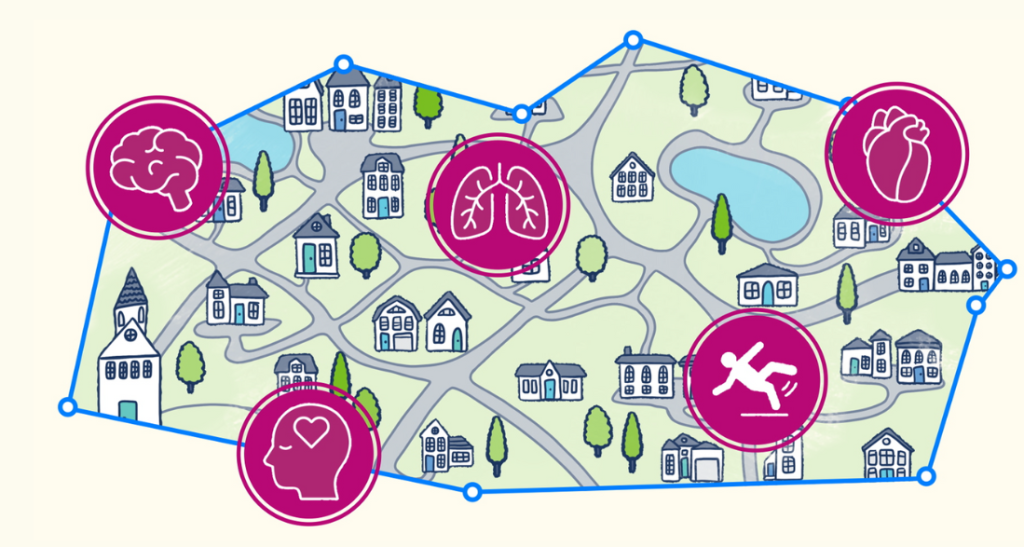
Using technology to help us, help you.
Nobody likes ending up in hospital unexpectedly. That’s why we’re using a new digital tool.
This tool helps us use data to spot people who may be at risk of becoming unwell.
If you’re identified, we’ll be in contact to invite you for a personalised assessment. So we can help you stay home, supported and doing what matters to you.
To find out more, speak to a member of staff or visit:
FAQs
‘Brave AI’ is the name of a digital risk assessment tool.
This tool helps healthcare teams use patient data more
effectively, so they can quickly identify people who may
be at risk of becoming unwell or who could benefit
from extra support.
‘Artificial intelligence’ or ‘AI’ refers to the simulation of
human knowledge by computer systems. In the Digital
Neighbourhoods Programme, AI supports health and
care professionals perform a task they already do -
analysing routinely held patient data.
By using AI to look for patterns in patient data, rather
than doing this manually, health and care professionals
can ‘risk assess’ the likelihood of a person becoming
unwell much more quickly and effectively.
Broadly speaking, a ‘risk assessment’ is the process of
identifying what could cause harm and putting
measures in place to prevent it.
In the context of the Digital Neighbourhoods
Programme, a risk assessment is something done by
health and care professionals to understand the
likelihood of a person becoming unwell. If someone is
identified as ‘at risk’, they can be contacted and invited
to take part in a personalised assessment, to help them
stay well and avoid any risks to their health.
Patient FAQs
Brave AI helps GP practices better use patient record
data they already have on file, by rapidly assessing a
person’s risk of going to hospital unexpectedly in the
next 12 months.
It does this by using an algorithm to look for patterns in
anonymised patient data and generating a personalised
risk assessment score.
In this context, an algorithm is a structured set of
instructions that AI uses to conduct tasks.
If a person is identified as needing extra support
through the Brave AI review, they may be contacted and
invited to take part in a conversation about their health
and wellbeing.
Integrated neighbourhood teams, made up of a range
of health and care professionals, can then work with
patients to develop a personalised care and support
plan for their needs - asking ‘what matters to you?’
instead of ‘what is the matter with you?’.
Personalised plans may include support delivered in person,
online or in the community - such as local classes
and groups – or using digital tools and technology to
help people to stay well at home.
This neighbourhood health model means the NHS can
deliver more care at home or closer to home, improve
people’s access, experience and outcomes, and ensure
the sustainability of health and social care delivery